Your cart is empty
Tap or click anywhere to close
Tap or click anywhere to close
Guides
The night sky on any date can be worked out to the minute for any place on Earth, also far back in time. Three things are needed: the place, the date and the time. They decide which stars stood straight overhead, which had just risen in the east and which were setting in the west.
The stars keep their places among each other. What changes is where you stand and when you look:
Almost. On the same date and at the same clock time, the stars stand within about a degree of where they stood the year before, because the calendar follows the Sun. Over a lifetime the stars hardly move against each other. The slow wobble of the Earth's axis shifts the whole sky about one degree in 72 years.
What does change from year to year are the Moon and the planets, which wander across the stars. A star map draws the stars and the constellations, so two maps for the same place and clock time, one for the day you were born and one for your birthday this year, show the same stars in nearly the same places.
A date long ago works as well as last night. The calculation needs the place and the time on the clock there. Time zones and daylight saving time have changed over the years, so the clock time is converted with the rules that applied at that place on that date. One hour wrong turns the whole sky 15 degrees, one minute wrong a quarter of a degree.
If nobody remembers the exact time, choose it roughly. A quarter of an hour off moves the stars less than four degrees, and the constellations stay the same.
The stars are in the sky in daytime too. The sunlight hides them. A star map shows the stars that stood above the place at that minute as they would look without the Sun, so a map for a summer afternoon shows a full sky.
A star map shows the whole sky above the place, as if you lay on your back and looked straight up:
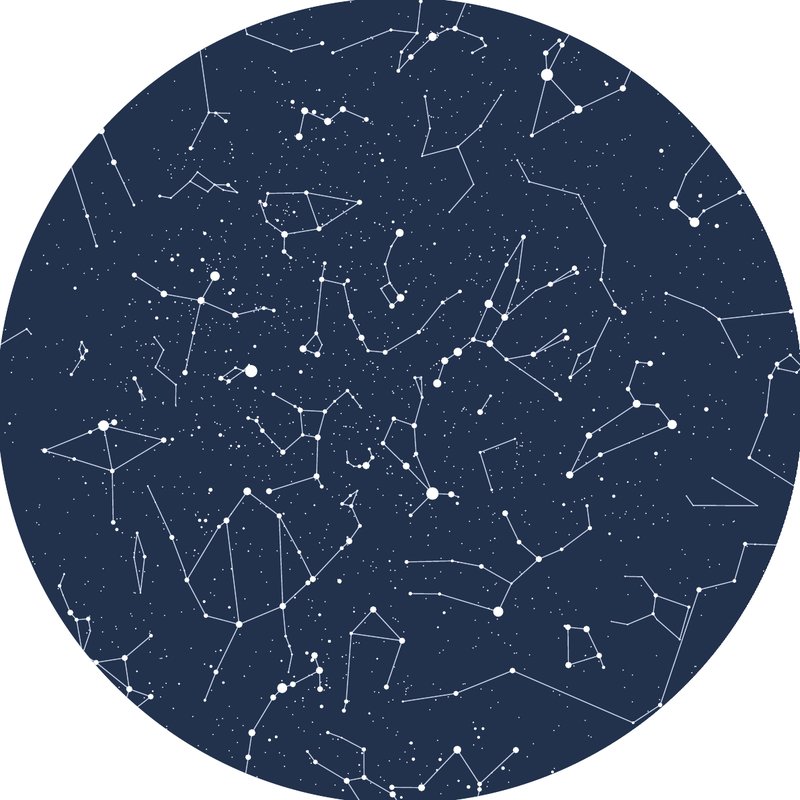
The North Star is a good check. It stands a little above the centre on a map for a place far north, and closer to the top edge the further south the place is. South of the equator it is below the horizon and not on the map.
Each map is calculated for its own place, date and minute when you make it:
You can check a map yourself with a free planetarium program such as Stellarium: choose the same place, date and time. The constellations straight overhead and those on the horizon should be the same. A program that shows the sky like a map of the ground looks mirrored next to the poster.
On a star map from Lovely Baby Print the sky is printed with one or two names, the date, the place and its coordinates, and the time can be shown or hidden. It suits any day you want to remember, from the day a child was born to a wedding, an anniversary, a birthday or the evening you met. The sky comes as a circle, a square or filling the whole poster, in 50 × 70 or 70 × 100 cm.
The tool opens straight away. You can change everything before you order.
30-day satisfaction guarantee. We're so sure you'll love your poster. If you're not happy, we'll take it back within 30 days, no reason needed. You only pay the return postage. How the guarantee works